Color as a game mechanic is almost as old as video games themselves. Long before touchscreen phones, designers realized that color is the fastest signal the human brain can process — faster than text, faster than shapes. That single insight shaped decades of game design.
The puzzle era: color as logic
Early color-driven games treated color as a sorting problem. Falling-block and bubble-matching games of the late 80s and 90s asked players to group like colors under time pressure. The challenge was cognitive: plan ahead, manage the board, don't drown in mismatched pieces. These games proved that a color rule needs no tutorial — players understand "same color = good" instantly, in any language.
The reflex era: color as timing
The 2000s shifted color from logic to reflex. Rhythm and reaction games began using color-coded lanes and gates that demanded split-second recognition. The question was no longer "where should this color go?" but "is my color aligned right now?" This is the direct ancestor of the mechanic in Candy Jump: a moving field of colors and a single correct moment to act.
The one-tap revolution
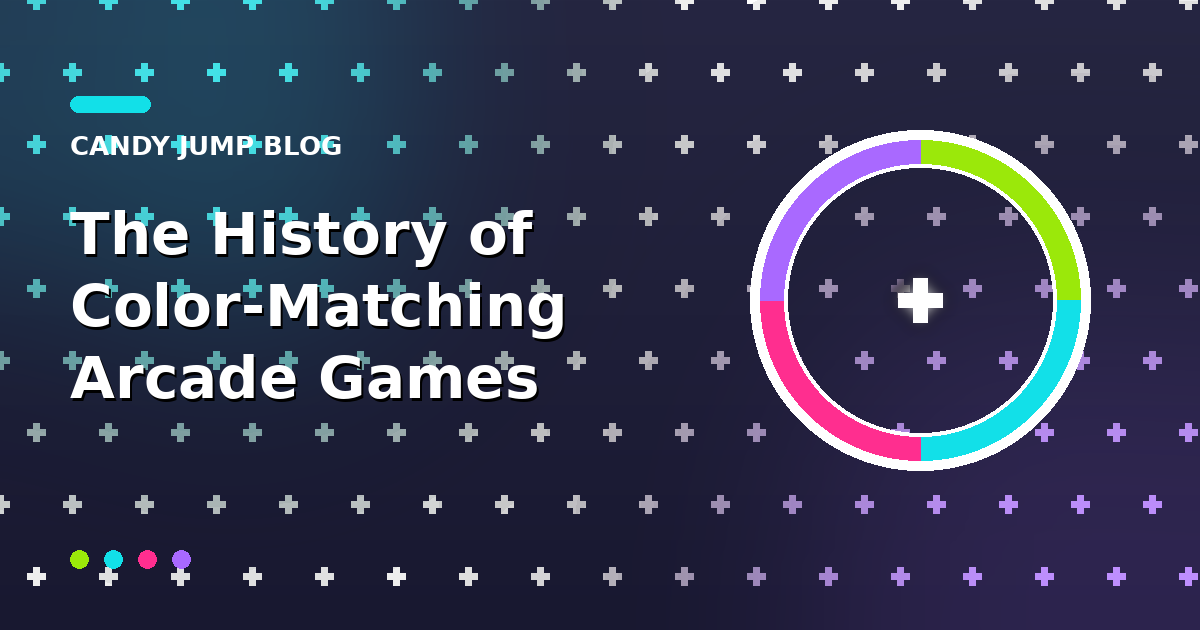
Touchscreens changed everything. With no buttons or joystick, mobile designers compressed entire control schemes into a single tap. Around the mid-2010s, a wave of one-tap color games appeared in which a ball hops through rotating color wheels, passing only through its matching segment. The formula was perfect for phones: sessions of thirty seconds, one-thumb play, and a rule you grasp before your first death.
Why the mechanic never gets old
Color-matching survives every hardware generation for three reasons:
- Zero learning curve — color equivalence is understood by toddlers and grandparents alike.
- Infinite difficulty scaling — spin things faster, add more segments, reverse directions; the rule stays simple while the challenge grows.
- Clean feedback — you always know exactly why you lost. Wrong color, wrong moment. No unfair deaths, no confusion.
The browser renaissance
Today, HTML5 lets these games run instantly in any browser with no download — bringing the genre full circle back to the "walk up and play" spirit of the arcade. Candy Jump belongs to this modern lineage: a rotating gauntlet of green, cyan, pink and purple, one glowing star per obstacle, and a rule you already understand.
Decades of design distilled into one tap. That's the quiet genius of color-matching games.